Helsinki Film Cowboys Go Global

Helsinki - “I would not be surprised,” Olli Alho, Finland’s leading film historian wrote in 1987, “if sometime in the 1990s…Finland would turn into an interesting cinema country, as Poland, Hungary, Switzerland, Sweden, and Czechoslovakia have all been in their turn.”

Traditionally, Finland’s small film industry has produced rural comedies and nature driven fantasies geared exclusively for that hermetic Nordic country of lakes and forests and midnight sun. Occasionally, a Finnish product of universal appeal will become an international hit, as Edwin Laine’s great anti-war epic, “The Unknown Soldier” did in 1954, but generally speaking Finnish film has been an acquired taste accessible only to Finnish speakers.

Unfortunately too, there has been little government support for cinema in Finland, especially as compared with neighboring Sweden, with the result that aspiring Finnish filmmakers of talent or more commercial outlook have fled to Stockholm, Paris and other points.

At least one such disaffected Finn, Renny Harlin, the director of “Die Hard II” and “The Adventures of Ford Fairlane” (whose first made-in-Finland film “Born American” was partly censored because of excessive violence” has achieved mega-success in Hollywood, while embracing what many Finns consider alien values.

Not so with Aki and Mika Kaurismaki. For the past decade this pair of Finnish writer-directors and their modest, Helsinki-based production company, Villealfa (named after Jean-Luc Godard's 1965 New Wave hit, "Alphaville"), has been issuing a steady stream of features and shorts employing Finnish settings and Finnish themes, with their own puckish twist, and garnering increasing attention from the greater cinema world.

The younger and more driven of the brothers, 33-year-old Aki, has rapidly gained a reputation as the new enfant terrible of European cinema. His 1989 feature, “Ariel”, a Finnish film noir that is a sort of cross between “High Sierra” and “Breathless” but set in the even more shadowy world of Helsinki, created a sensation at last year’s Cannes Film Festival.

More recently, “Leningrad Cowboys Go America,” his cracked paean to the American road, about a hirsute Finnish polka band turned American rock combo, opened to more rave reviews.

In addition to their own filmmaking activities, Mika and Aki are co-sponsors of the world’s northernmost film festival, the Midnight Sun Film Festival, which is held every year in the Lappish city of Sodankyla, at a time in June when the sun never sets.

And Villealfa is also active in distributing foreign films in Finland, including those of Aki’s close friend and filmic comrade, Jim Jarmusch (who makes an appearance as a used-car dealer in "Cowboys”).

Even the Finnish government is finally taking note of the Kaurismaki’s creative machinations. The government recently announced that it was adding 45 million markaa (about 12.5 million) for grants to independent filmmakers in the next year’s budget.

Escape, a key theme of traditional Finnish film, is also a central theme of both the Kaurismaki brothers’ films, although they tend to stand it on its head. Thus, in Mika’s best-known film, “Helsinki (Napoli) All Night,” made in 1985, the comic hero, a Finnish expatriate working as a cab driver in Berlin, flees to Finland while eluding the German mafia, after botching a job for them.

By contrast, Aki’s less voluble characters are usually trying to escape in the other direction - namely, out of Finland. For example, in “Ariel”, the star-crossed lovers wind up on a freighter headed for Mexico, while a Finnish rendition of “Somewhere Over the Rainbow” wafts incongruously over the credits.

The seemingly lobotomized musician-ber-serkers of “Leningrad Cowboys” also wind up in Mexico, after cutting a cacophonic swath across the American South.

Clearly, Aki Kaurismaki has mixed feelings about his homeland. The Finland depicted in his work is a country afflicted by the spiritual malaise of urban capitalism, yet leavened with humor and simplicity of a society that is still rural at heart. Thus, at its best, as in “Ariel,” or the 1986 “Shadows in Paradise”, perhaps Kaurismaki’s most accomplished work, a romance between an inexpressive garbage man and a suller supermarket cashier, is oeuvre attains a certain balladic quality.

Aki's mixed feelings about his little understood native land were also evident during a recent interview in New York, while the director was in town to promote “Cowboys” and present two of his newest works, “Match Factory Girl” and “ I Hired a Contract Killer,” to the New York Film Festival.

He confesses to a strong nostalgia for the days of Urho Kekkonen, the benevolent tyrant of a president who dominated Finland during the 1960s and 1970s - which helps explain why there is a picture of Kekkonen in almost all his films (he’s the bald one with the glasses).

“He was a man,” the laconic, leather-jacketed Finn said, referring to Kekkonen, in between bursts of his ever-present cigarette.

Since Kekkonen’s forced retirement in 1981 - just about the time Kaurismaki, a former journalist, began making films - “everything has gone downhill.” So why make films in Finland? “Because I am Finnish,” he shrugged.

And what would he do if he had more money? “I would make worse films.” End of interview.

Aki’s most frequently used actor, and the closest thing that Finland has to a film star, the irrepressible Matti Pellonpaa, is considerably more expansive than his friend, Ak; the two have known each other since growing up in the back lots of the Finnish Capital.

Indeed, an interview with the shaggy-haired, self-consciously bohemian actor, who plays Vladimir, the band manager in “Cowboys”, was something of a riot; it took place, as do most of the actor’s social and professional meetings, at the Kosmos, a kind of Finnish Brown Derbycum-hangout where the young Helsinki intelligentsia congregates on weekday evenings. Pellonpaa and Kaurismaki are main attractions.

“I am a Communist because I am not a Communist!” the tipsy thespian boomed, while receiving a steady stream of solicitous female fans. “There are no small roles - there are only small actors!”

Subsequent, soberer exchanges revealed the 39-year-old actor to be seriously devoted to his craft, to the Kaurismakis, and to Finland, in about that order. Pellonpaa attributes his success, in part, to his dual training as an actor and a cameraman; indeed, he began working for the Kaurismakis as a key grip.

Nevertheless, he assigns the greatest part of the credit to Aki Kaurismaki’s faith in him. “Who would've thought that I could become a star with this face,” Pellonpaa said, smiling and pointing at his grizzled visage.

The actor’s success is a relative thing. He earns only about $30,000 a year, still not enough to afford his own apartment in super-expensive Helsinki. And he doesn’t have an agent; there aren’t many agents in Finland - yet. And Pellonpaa, who likes the coziness of the Finnish film scene, such as it is, would like to keep it that way. As far as he is concerned, he gets enough attention at the Kosmos.

“I want to be an actor - not a poster!’he exhorted, once again in his cups, before sliding back to his table and waiting coterie.
Baltic Hands Link Across a Troubled Sea

From Financial Times, April 8/9, 2000

A new dynamism and unity is rolling across the previously divided region. But the birth of Homo Balticus is not without its problems, writes Gordon Sander.

Some call it the new Baltic renaissance, or the resurgent Baltic Brotherhood. Others call it the New Hansa - a resurrection of the powerful league of Baltic city-states that revolutionised commerce during the medieval ages, and turned the storm-tossed East Sea, as it was then known, into the mainspring of continental trade.

Whatever you call it, there's a buzz about the Baltic. What was until recently little more than a heavily polluted body of water divided by a "Baltic Wall' has rapidly evolved into the most dynamic, politically unified region of Europe, and an area responsible for 15 percent of the world's trade. The Economist magazine has called it "the biggest and most promising piece of the New Europe". Much of that Baltic buzz is lathered up by the many regional alliances and organisations that have sprouted up along the Baltic shores. It seems the 80m or so people who live and work in the Baltic basin have a propensity for joining organisations. Among the many to which they have subscribed are the Union of Baltic Cities, the Baltic Seas Chamber of Commerce, the Baltic Council of States, the Foundation or the Baltic Sea.

Inevitably, these organisations often work at cross purposes but somehow they get along. However, there is one transnational body: causing controversy among the 10 nations of the pulsing Baltic region; Nato. Therein lies the biggest cloud overhanging Mare Balticum and the countries or regions that border it: southern Norway (even though Norway technically doesn't front on the Baltic), Sweden, Finland. the St Petersburg region of Russia, Estonia, Latvia and Lithuania, the Russian Kaliningrad enclave, northern Poland. northern Germany and Denmark. Perhaps the most dramatic example of how rapidly the Baltic shores are converging is the remarkable rapprochement between Finland and the country between Finland and the country directly facing it 50 miles across the foam-whipped waves, Estonia. The two contiguous countries share strong historic, cultural and linguistic ties. However, for the half century after the second world war - when formerly free Estonia became the Estonian SR, while Finland kept its independence and its capitalistic way of life - the Finnish and Estonian peoples were estranged. Until a decade ago, tourism and cultural exchanges between the two nations was minimal and closely monitored. Now, Finland and Estonia are each other's biggest trading partners and tourism between them has grown dramatically. In 1989, before the break-up of the Soviet Union, about 200,000 Finns and Estonians were allowed to visit each other. By last year, that number had soared to almost 3m. "A rainbow of relationships has formed between our two countries and the number of bands in that rainbow is steadily increasing, ' said an Estonian diplomat in Helsinki. Brotherly Finns are also helping to train the Estonian military and police forces, supplying funds and expertise for the clean-up of the Soviet-abused Estonian environment- including the Baltic itself- and training Tallinn's tiny bureaucracy for its future duties as a member of the European Union. There is even a brave new Finnish-Estonian Symphony Orchestra to set the new marriage to music. The Finnish-Estonian reconciliation has, in turn, inspired the other richer Nordic nations to "adopt", invest in, and bond with their neighbours to the east. Much as Finland has "adopted" Estonia, so Sweden has done with Latvia, and Norway and Denmark with Lithuania. Increasingly, Germany and the Nordic countries are viewing the lower Baltic region as part of their home market - as well as a bridge to the larger Russian market. Perhaps the most concrete manifestation of the Baltic renaissance is an actual bridge: the huge, recently completed Danish-Swedish Oresund Bridge that links the Scandinavian land mass with the European continent for the first time, creating a new metropolitan region of 3m people around Copenhagen and Malmö, and a trade and marketing centre as large as that of Amsterdam, Berlin or Zurich. What was until recently a polluted body of water divided by a 'Baltic Wall' is now responsible for 15

percent of world trade So today, there is, arguably, a greater convergence of peoples, cultures and economies around the Baltic than at any time since the medieval Hanse trading league ruled the Baltic waves which explains the vogue of the so-called "New Hansa" concept as a rationale for the new Baltic synergy. The Hanse was founded during the late 12th century by Lübeck- based Saxon merchants who wished to protect and store the valuable cargoes they shipped back and forth across the East Sea. Subsequently, the Hanse merchants established commercial enclaves along the Baltic and beyond, both in established cities such as London (where the Hanse had. offices at the Steel Yard), and Copenhagen, and in young coastal habitations such as Rostock, Riga and Tallinn, which became city states. The Hanse members and outposts, which ultimately numbered more than 160, were linked by a sophisticated commercial network that included a uniform type of boat (the cog), advanced navigational aids and occasional diets to discuss interleague problems. From the 13th century until well into the 16th, this huge protective association dominated Baltic trade. Ultimately, the Hanse was eclipsed by the better organised and armed Dutch, but not before creating the foundation for a region-wide identity, and myth, which has continued into the present day. Today, along the German Baltic coast, where the Hanse originated, the name is a virtual mantra. In Rostock which calls itself the Hanseatic City of Rostock - I counted a Hansa bank, a Hansa amusement park and a Hansa soccer team. Yrjo Kaukiainen, who teaches maritime history at Helsinki University, thinks there is a tendency to idealise the original Hansa. "When you take away the trimmings the Hanseatic houses, the diets - what Hanse was really about was making money, which is fine, but to speak of a higher Hanseatic ethos is going a bit too far. "The Hanse could be quite an aggressive organisation and was perfectly willing to engage in boycotts, embargoes, even outright war to accomplish its ends," he said.

Perhaps the most visionary (or the most deluded) of the new Baltic leagues is the Union of Baltic Cities, which has 92 members ranging from little Ventspils (Latvia) and Panevezys (Lithua- nia) to mighty Stockholm and St

Petersburg. Among other things, this energetic voluntary association has enunciated a new enlightened creed of man; Baltic Man. According to a UBC brochure, Homo Balticus is hard-working, neighbourly, nature-conscious and aesthetically sensitive. He also likes to talk. One of the more interesting and worthwhile UBC services is the bulletin published by its Rostock-based Commission on Health and Social Affairs, which allows poorer members to advertise their sometimes desperate material needs.

n a recent issue Narva, Estonia, appealed for incubators and computers; Kaunas, Lithuania, sought furniture and washing machines; and Kaliningrad pleaded for disposable syringes, disinfectants, knitting machines and food. "The members are responding," said Karin Wohlgemuth, the bulletin's editor, who is also Rostock's head of foreign relations.

"I believe in Homo Balticus," she continued, as she stood in the rain, near the town's old Hanseatic harbour. "I feel a kinship with Finns and Estonians. We know each other. And now we need each other." Alas, all this goodwill notwithstanding, Homo Balticus still has considerable woes. One of them, the spread of organised crime, is a direct consequence of the fall of the Baltic Wall. "Opening the borders between Finland and Estonia has been a mixed blessing for us,” said Antti Turkama, top officer of Helsinki's

Dispite all the goodwill, Homo Balticus still has considerable woes, including the spread of organised crime

National Bureau of Investigation. "Ten years ago Holland was the principal source of drugs imported into this country. Now, I am sad to report, it's Estonia." Another serious problem for the Nordic countries is the increase in the smuggling of illegal immigrants across the reopened Baltic. Another impediment to true Baltic harmony is the varying speeds at which Estonia, Latvia and Lithuania are being taken into the EU. Estonia, deemed by Brussels to be the fittest of the three, was invited on to the fast track to EU membership three years ago. Latvia and Lithuania were finally given the go-ahead at the December EU summit in Helsinki, but hard feelings remain. One could argue that, at least in the short run, both EU and European monetary union, about which the Baltic Ten also differ, have brought as much turmoil to the Baltic region as brotherly love. Then there is the matter of the Baltic itself, which, despite a vast amount of transnational environ- mental aid from green-minded Germany and the Nordic countries, remains grossly polluted The Swedish government already advises pregnant women and children not to eat fish caught in the Baltic. The principal culprit, by common agreement, is Russia which still flushes vast amounts of untreated sewage into the sea at St Petersburg and Kaliningrad. "We understand the problem,” said a Russian diplomat in Helsinki "And we are glad that [other nations] are willing to work with us on it. But we are doing our best.”

The Russian was also pleased to point out that St Petersburg had recently hosted the 10th Annual Hansa Business Days, which drew high-level delegations from around the Baltic "We are all for the New Hansa,

he said. "And despite what many people think, we are for the EU. too. Anything that brings business to Russia is good. However, the Russian's smile disappeared when the trouble- some matter of Nato expansion into the Baltic was raised. Germany, Norway and Denmark are, of course, full members of the western security alliance, while Finland and Sweden, with significant defence forces of their own, have chosen to remain discreetly out.

But Estonia, Latvia and Lithuania consider Nato membership intrinsic to being accepted back into the western family of nations. They emphatically want in - to the manifest distress of Moscow, which continues, rightly or wrongly, to perceive Nato as an anti-Russian military alliance. "We are adamantly opposed to these countries joining Nato,” the Russian said. "There is a broad consensus among the Russian people about this matter." Something about the prospect of the three Baltic republics joining Nato clearly makes the Russian bear livid. As Kremlinogist George Kennan pointed out in a recent interview with The New York Review of Books, the republics "were part of Russia longer than they were part of anything else" (Kennan is opposed to Nato enlargement). Moscow's vehement opposition to Nato expansion was re-emphasised in a gravely worded, anti-Nato, anti-western "security concept" it published recently. That has not, however, changed minds in Tallinn, Riga or Vilnius, where the predominant attitude remains Nato or bust.

Russia is also put out by the second-class treatment it feels is being accorded the large Russian- speaking populations of Estonia and Latvia, a matter which greatly vexed Boris Yeltsin. Clearly, the potential for a future Russo-Baltic conflict is there, which is why some pessimists predict that the present era of Baltic goodwill will prove about as brief as the last one, which ended in 1939 when Stalin's armies came storming across the Finnish Russo border, and, a year later, occupied Estonia, Latvia, and Lithuania.

Homo Balticus, staring hopefully into the Baltic mist, believes otherwise.

Free and Frank

From The Jewish Chronicle, September 21, 2004

Gordon F. Sander recalls the ordeal, in war-time Holland, of his mother’s family - the Franks who survived.

Nine days after Anne Frank's family went into hiding - or, as it was called in those times, "dived under” - my mother Dorrit, together with her parents, Myrtil and Flory Frank, and her sister Sybil, spent the first of 1,022 days concealed at Number 14 Pieter van de Zandestraat, a small, side-street flat in The Hague. And, just as their namesakes did in Amsterdam, my mother's family had many close shaves, living, as they did, but a few minutes' walk from Gestapo headquarters.

The closest was probably that of November 21, 1944, when a German slave-labour party conducted a house-to-house search of their previously overlooked street. By then, Anne and her family, as well as the four other "divers" at 263 Prinsengracht, Amsterdam, had, like so many, been betrayed, and dispatched on the penultimate train to Auschwitz and (except for Otto Frank) to oblivion.

But, five months after D-Day, resigned to losing the war, and already beginning to cover up their tracks, the German overseers of occupied Holland were no longer actively looking for Jews.

They were satisfied that they had already found and exterminated most of Holland's pre-war Jewish population of 140,000. And indeed, nowhere in Western Europe was the Holocaust carried out as thoroughly as it was in The Netherlands.

But, although they were no longer looking for Jews that November day, for ever seared into my mother's memory - and, later, mine if the Germans had found any, they would doubtless have killed them on the spot.

And yet, somehow, the search party went past Number 14. Why? How? God's will, said my grandmother, the most religious of the four. Destiny, insisted my mother, the most romantic. Chance, said, my aunt, the least sentimental of the Franks, when I interviewed her years later. Unfortunately, I never had the chance to speak in detail about these matters to my grandfather, Myrtil, who originally took the courageous decision to take the family "under."

There was still much to get through. In fact, the worst part of the Franks' ordeal, the so-called "Hunger Winter" of 1945, still lay ahead. Some 20,000 Dutchmen, including many of the estimated 25,000 Jewish "divers" who had somehow survived until then, were to perish during the horrific last half-year of the war, when the Germans allowed Western Holland, one of their last redoubts, to starve.

In addition, the Franks - my Franks - like their fellow Hagenaars, had to face the danger of misfiring V2s. The rockets, which the Nazis launched against London, often fell backwards, incinerating swathes of The Hague.

And yet, incredibly, on May 8, 1945, more than 1,000 days after they had first "dived under, the Franks emerged into the bright sunlight of freedom, one of a handful of Jewish families who survived, underground and intact, the entire German occupation and the DutchHolocaust, in which 80 per cent of Dutch Jewry perished.

Even though after years of research and hundreds of hours of interviews with members of my family - and now, with a fairly clear idea of what they endured during those thousand days and what transpired behind the door of No. 14 Pieter van de Zandestraat - I still find myself today standing in front of that same flimsy door, wondering, how they managed to survive.

So, was it God, destiny or chance? Or was it a combination of all three?

Saving Lives in Ukraine

From Harvard Magazine, September 13, 2022

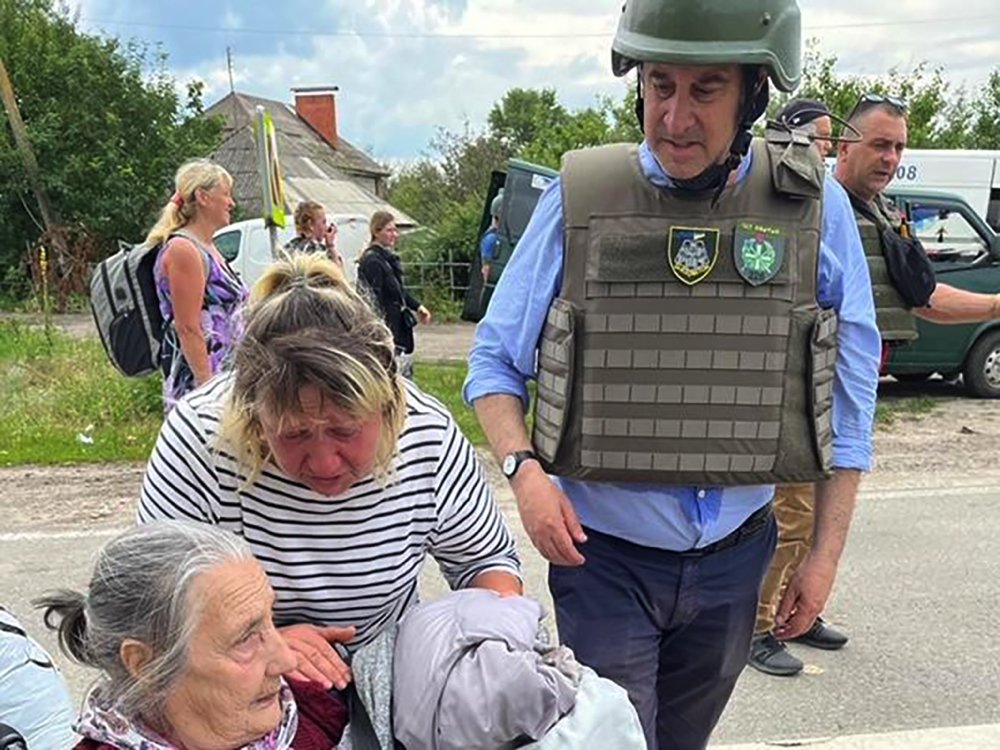
Brooks Newmark ’80 with an elderly Ukrainian woman

Photograph courtesy of Brooks Newmark

“When I see a problem I have this urge to solve it no matter how formidable it might be,” says Brooks Newmark ’80, M.B.A. ’84. “While I don’t have an official charity organization behind me, I have a lot of energy.” 

Newmark, a transplanted American who was formerly the Minister for Civil Society in the government of British prime minister David Cameron and a member of Parliament, was describing the most formidable problem he has ever taken on, either as a government officer or private citizen: that of shepherding Ukrainian women, children, and the elderly caught up in the war that has devastated their country out of harm’s way. 

Newmark, a successful businessman before he entered public service, working with a Latvian friend, has been astonishingly successful. As of this writing, they and the Dunkirk-like fleet of 16 Ukrainian and Lithuanian buses they have improvised, along with a dedicated cadre of helpers, have moved more than 14,000 people of all ages, including several hundred orphans and amputees, away from the war zone to safety, often under fire. 

At one point, Newmark recalls, a Russian mortar bomb landed several hundred feet from his car while he was driving to the border of the Russian-occupied zone in Kharkov Oblast. “That certainly brought home the reality of the war,” he says. “Until then I had thought that I was personally immune from just about anything.” 

That has not stopped Newmark, who Moshe Azman, the Chief Rabbi of Kiev, has called the Oskar Schindler of Ukraine, after the Holocaust rescuer hero. Newmark himself shies away from that title while acknowledging that he is impelled by his own Holocaust history. “I had family from Poland and Lithuania who perished in the Holocaust,” he says. “What happened at that time is hardwired into the consciousness of Jews of my generation. But also hardwired into me is the notion that there were some who stood up to be counted in the Jewish people’s hour of need. Now I would like to think that I am one of those who is standing up for the Ukrainian people in their hour of need.”

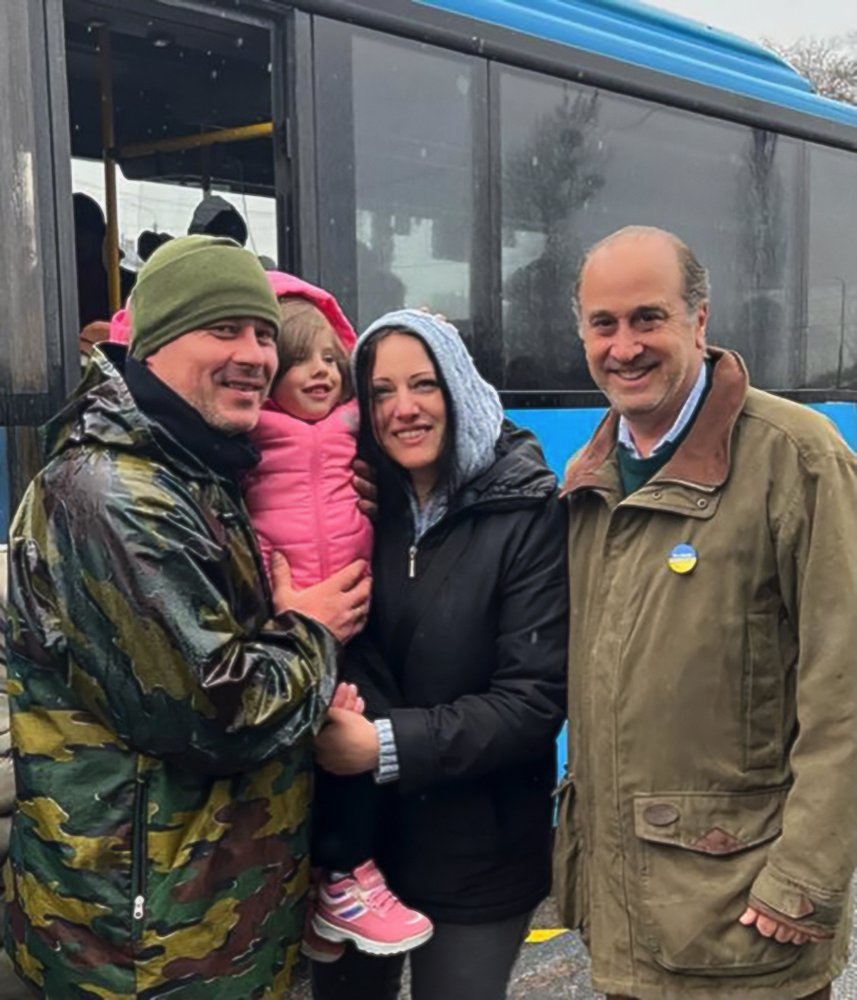
Newmark with a Ukrainian family
Photograph courtesy of Brooks Newmark

Newmark’s Ukrainian project is not the first humanitarian mission in which he has invested his time and personal wealth. Though based in London, he has previously worked at a Syrian refugee camp in Turkey, helped to rebuild an orphanage in Pakistan, and renovated a children’s home in Sarajevo. Prior to Ukraine, his most sustained effort had been in Rwanda, where he opened and financed a primary school for 300 children, a teacher-training center, and an education charity which he frequently visits and oversees.

Still, none of these quite prepared him for what he would see and experience, or how engrossed he would become, once he arrived in Ukraine in March. Newmark was actually in Rwanda completing research for his doctorate in education policy at Oxford when he saw a post from his Latvian friend, who had volunteered to transport Ukrainian refugees to safety and decided to pitch in. 

“This experience has been like mission creep for me,” he says. “What started off as a few days on the Polish Ukrainian border has now developed into an all-consuming call to arms, as well as a life-changing—and most urgently, life-saving experience,” in Europe’s worst land war since World War II.  “The utter devastation of civilian areas early in the war, especially in Bucha, Irpin, and Bordyanka—the towns near Kiev—really got to me,” he recalls, still haunted at the memory. “Every house had been blown up. Most shocking of all was seeing a mass war grave in Bucha and knowing that there were 458 bodies buried there.” 

“The sight of a solitary shoe lying on top of the mud really struck me for some reason,” he says, his voice trailing off.

“The Russians are beyond evil,” says Newmark flatly, “and [Vladimir] Putin is devoid of any humanity. He is willing to kill as many Ukrainians as possible to get control of Ukraine. He simply does not want Ukraine to exist as a sovereign nation.”

Newmark, along with his ad hoc Latvian-Swedish team, helped guide more than a thousand people through a live minefield to safety in the eastern Kharkov region in July. “The evacuation had taken weeks of meticulous planning,” he recalls. ‘The day before I was supposed to get them through the no-man’s land between the Russian Ukrainian check points I discovered that there were 500 meters of anti-tank mines between them. Fortunately, I managed to persuade the Ukrainian military to create a path through the minefield.

“We then waited and waited. Suddenly coming around the corner towards our checkpoint were a few elderly ladies, a mother with two children, a twenty-something-year-old woman with two Alasatian dogs, followed by more and more women, children and pets and the odd elderly man. We waited until there were about 200 people at the check point. I couldn’t believe it!  This was actually happening. Amazingly, 1,015 women and children ultimately took the risk to walk through the path I had organized for them.”

And how does Newmark’s  family feel about the risk he takes when he flies to Ukraine to continue with his campaign? “I think my family is proud of what I am doing,” he says, referring to his  wife, Lucy, and their five children, Benjamin ’10, M.B.A. ’16, Sam ’14, Max, Lucy, and Zachary. His wife, he says, "has been with me for 40 years and knows me well enough to understand that I am happiest when I am out doing something to solve problems.”

Return to No. 14

From Amsterdam Weekly, October 2004

A visit to the little street where the “other Frank family” survived the war.

Sure, I had been to No. 14. Pieter van den Zanderstraat before.

I’d first seen this little street of two storey flats in The Hague long ago, during the summer of 1965. The Western world was then in the grip of Beatlemania and I was a semi-precocious nerd of 14. Unlike some Holocaust survivors, my mother hadn’t told me very much about her experiences as an onderduiker. I was aware of the outlines of her story, but that was all.

How could she convey what she, her father, Myrtil, her mother, Flory, and her sister Sybil had experienced during their long ordeal hiding from the Nazis? Her father had prepared for the 'dive’ by planting the rumour at the grocery store that he was a German-Swiss doctor with a mad wife, a cover for nosy neighbours. The four Franks had then ‘submerged’ on 14 July 1942. In that flat they lived through three years of uncertainty, with the constant terror of being betrayed, as well as, towards the end, of being vaporised by an off-target V2 missile (many of which were launched from The Hague). Like other ‘divers who had survived, oncluding the other Frank family in Amsterdam, they had nearly starved to death during the hongerwinter of 1944-1945.

Then one day in July 1965, when we were on a commemorative tour of Europe, my mother took me to Pieter van den Zandestraat. She was returning for the first time since her departure for the US in 1947. She knocked on the wooden door of No.14 but for some reason-_fear of the unknown, maybe, and shyness- I held back. Instead, I ran across the street and took a melodramatic photo of the flat, which looked much as it must have to the four fugitives 20 years before. The curtains were closed, just as they had been when the Franks waited for the knock on the door that fortunately never came. My mother came out a short while later and we left. I put away the picture and the memory- of that visit and returned to my photography, my pimples, and my other preoccupations as a nerdy teenager growing up in America in the ‘60s. Sometimes the war did jut suddenly into sight. On one occasion during the early '70s I was watching Sidney Lumet's Cold War thriller, Fail-Safe, with my family. The film ends with a countdown and a montage of ordinary New Yorkers, unaware of their imminent demise from a bomb the US had agreed to drop in return for accidentally bombing Moscow. The countdown evidently triggered memories of the misfiring V2 missiles and mistargeted Allied bombs that had nearly incinerated my mother and her family, as they had so many of their hapless neighbours; she burst into hysterics as if that cinematic bomb was actually headed for our Queens, New York home.

But mostly my mother's war remained as opaque as the muslin curtains in the front of number of No. 14. She had handed down to me an interest in Holland and the Dutch, though, and I made an extended postgraduate trip here in 1974. In fact, I began my career as a foreign correspondent specialising in Holland and the Nordic countries. I spent two periods in The Hague in the mid and late '70s, but my personal history or for that matter, Holland's conflicted wartime history- weren’t yet my main literary interest. I even visited No. 14 once or twice, but I never could summon the courage to ring the bell. Then, in 1979, when I was 28, I decided to write something about my mother's experiences. My idea was to publish a version of my mother's story on what would have been Anne Frank's 50th birthday, to tell the story of what might have happened if the Amsterdam Franks had been as fortunate as their counterparts - my mother's family sixty miles away in The Hague. As they say, I wanted to do a mitzvah. As my mother recounted the endless days and nights of waiting and praying while the bombs and missiles fell, and the schutzpolizer searched the surrounding the streets, I realised why she had run away during the broadcast of Fail-Safe. I began to understand what she meant when she occasionally told me, when I was very young, that she felt she had been destined to get through it all. That was sort of heavy. Even more troublingly, my mother's interpretation of what had happened at No. 14 differed from those of my grandmother and aunt (my grandfather, Myrtil, had since passed on). Why had the Franks survived all of those endless days waiting in front of the curtains? Why, during the Franks' closest shave, a slave labour house-to-house search in November 1944, had the Germans inexplicably walked past No. 14? Destiny, my mother said. God, My grandmother, who was the most religious member of the family, asserted. Chance, said my aunt. Their different explanations influenced what they remembered of their experience. The absence of a diary or journal, like Anne Frank's, made it difficult to reconcile their contrasting accounts: Rashomon redux. Not surprisingly, the project went off the track. My intended mitzvah morphed into a personal crisis. A friend advised me to put the story aside for 10 or 15 years, until I had some perspective on it - and perhaps, too, until I learned more about the complicated Dutch experience of the war, and the tragedy within a tragedy that was the Dutch Holocaust. The question is often asked: why did the Dutch lose nearly 80% of their Jews? Why did so many of the Franks' fellow Jews, like Otto Frank and his sequestered family in Amsterdam, and 102,000 others, not survive? It was a difficult question to answer. It still is. In the end, the projected 10 or 15 year delay became 20 until one day in London, a few years ago. I mentioned the project in passing to a producer from BBC Radio 4, who said he would like to do something with the story. I wrote a radio series, “The Frank Family That Survived', and the radio series became a three-year book project. Evidently, I had gained the perspective and maturity I had lacked on my first mitzvah try during the intervening years. The hundreds of hours of research I conducted - including interviewing my poor mother to exhaustion- also helped to keep me on track. Even so, every time I visited Pieter van den Zandestraat to try and picture what my mother and aunt described to me, I found myself unable to ring the bell. It was as if I were afraid to find the four Franks sitting inside, benumbed, as they had been so often when they had hidden there, and especially on that one heart-stopping day in November 1944, when the Germans conducted a house-to-house search of their street for slave labour during which they came closest to being discovered. Last weekend, I decided that it was time to go inside. I went to The Hague, and to the Pieter van der Zandestraat, and rang the bell once, then several times. People started looking out at the street from behind their curtains. No one answered. I left a note saying that I'd be back that evening and left, somewhat disappointed. I'd come especially

for that reason and the anti-climax after working up my courage to ring was depressing. That evening I made my way once again through the dark, somewhat macabre streets of The Hague's centrum west, and rang the bell again. Nothing. Then, magically, a light came on. Suddenly I doubted whether the flat’s current occupant would let me in. It was late, and I hadn't exactly made an afspraak. In this country you don't knocking on people's doors late at night, unless it’s an absolute emergency. The man who opened the door turned Out to be very friendly. He told me his name was Klaas Pen and that he worked for a Dutch airline. He was happy to invite me inside. He'd heard something about his apartment being used during the war by onderduikers. He poured me a drink. I gave him my book. There were two surprises. The three-room apartment was handsomely renovated and seemed larger than it had been described. But then, the Franks had only used part of the apartment, which had been lent to them by my mother's Dutch teacher, a couragous woman by the name of Annie van der Sluis. It looked like a nice place for one man, especially with the use of the back garden (something which the Franks avoided). The other surprise was a secret compartment hidden in the back of one of the closets. Pen had discovered it when he had moved into No. 14 five years before. The space might just have been large enough for the four onderdwikers to stand in during a raid. Neither my mother nor my grandmother nor my aunt ever mentioned it. It certainly wasn't used during the slave labour raid in 1944. Perhaps my grandfather felt that there was no point. He always kept a revolver handy for such an occasion, which he never told the family about. Klaas and I sat there, nursing our drinks, reflecting on the miracle that had transpired within these same walls. Why did the Franks survive? One thing's for certain: the Franks’ neighbours on Pieter van den Zandestraat deserve some of the credit. Someone must have suspected something fishy was going on at No. 14, what with the various helpers going in and out. Still, no one told, not even during the hongerwinter, when a successful tip-off might have meant a possibly life-saving reward from the Nazis.

“This was a good street,” I said.

"Still is,” said Klaas.